» Brettzel

Brettzel

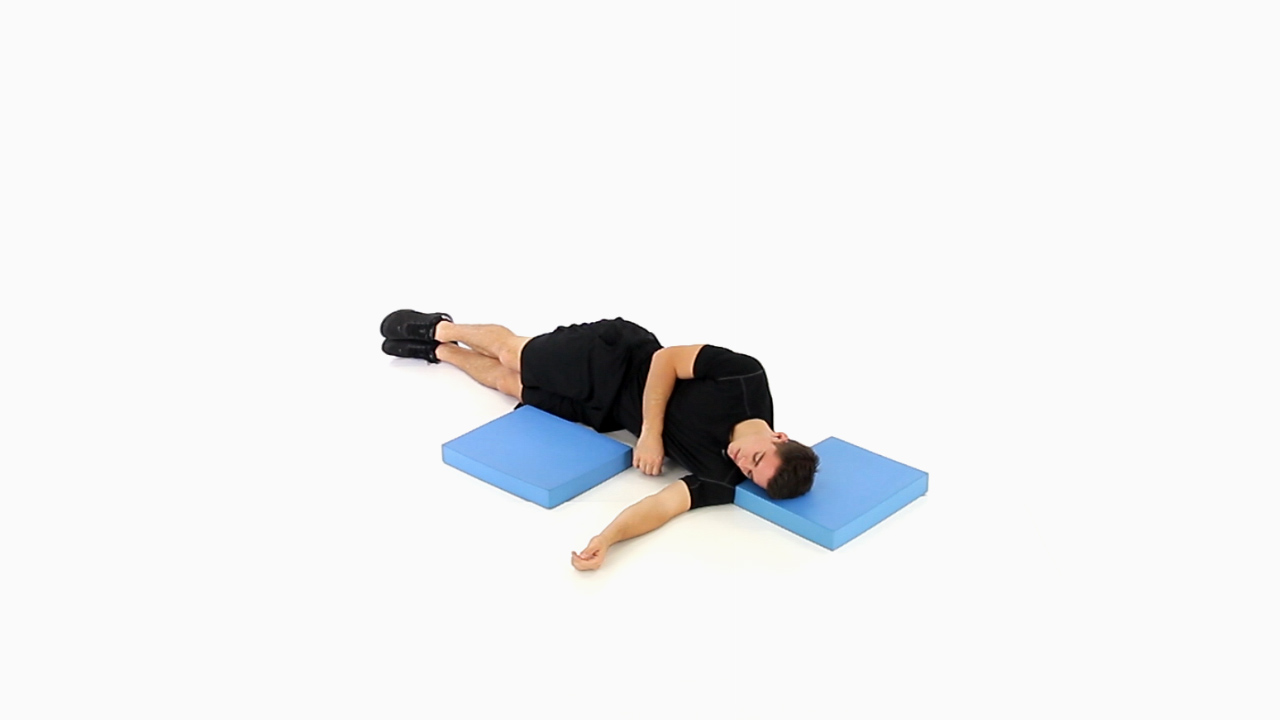
This is a total mobility exercise for the quadriceps, hips, piriformis, glutes, low back and thoracic spine that will aid in improving shoulder limitations.

Body Parts Targeted: RotationalGet Up

Starting Position: Side-Lying

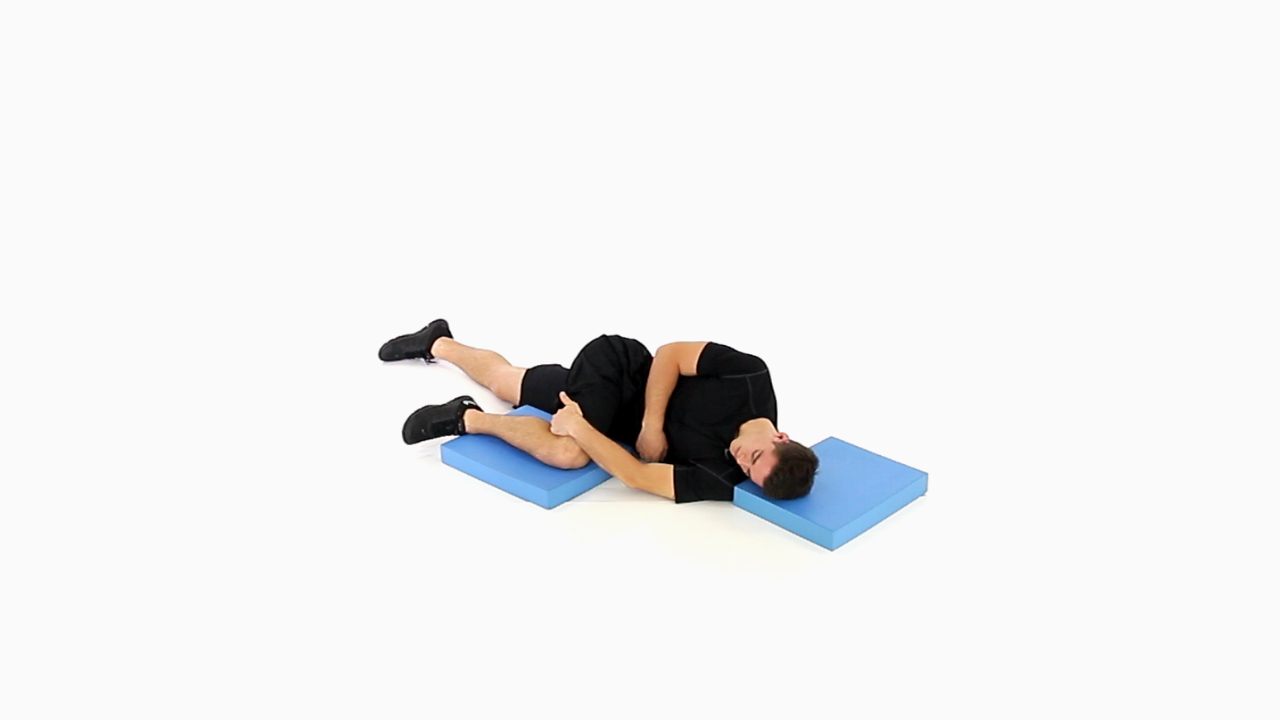
Lay  on  your  side  with  your  neck  supported  so  it  remains  in  a  neutral  position.    Since  your  shoulder  will be on the deck, elevate your head with a towel or  foam pad so that your neck is not  downhill, or uphill,  but  right  in  line  with  the  remainder  of  your  spine.   The  neck  should  be  completely  relaxed  during  this  stretch.    Draw  your  knees  and  hips  into  a  fetal  position, bending  at  your hip joint to create as tight of  an  angle  as  possible. The  angle  between your  thigh and  your torso should be  less  than 90 degrees.  If  you  are  extremely  flexible,  you  may  be  able  to  place your thigh directly onto your chest wall, but  it  is  important  to  take  up all  the  available  slack.   Assuming  that  you  are  lying  on  your  right  side,  hold  your left knee  close  to your body with your  right hand.

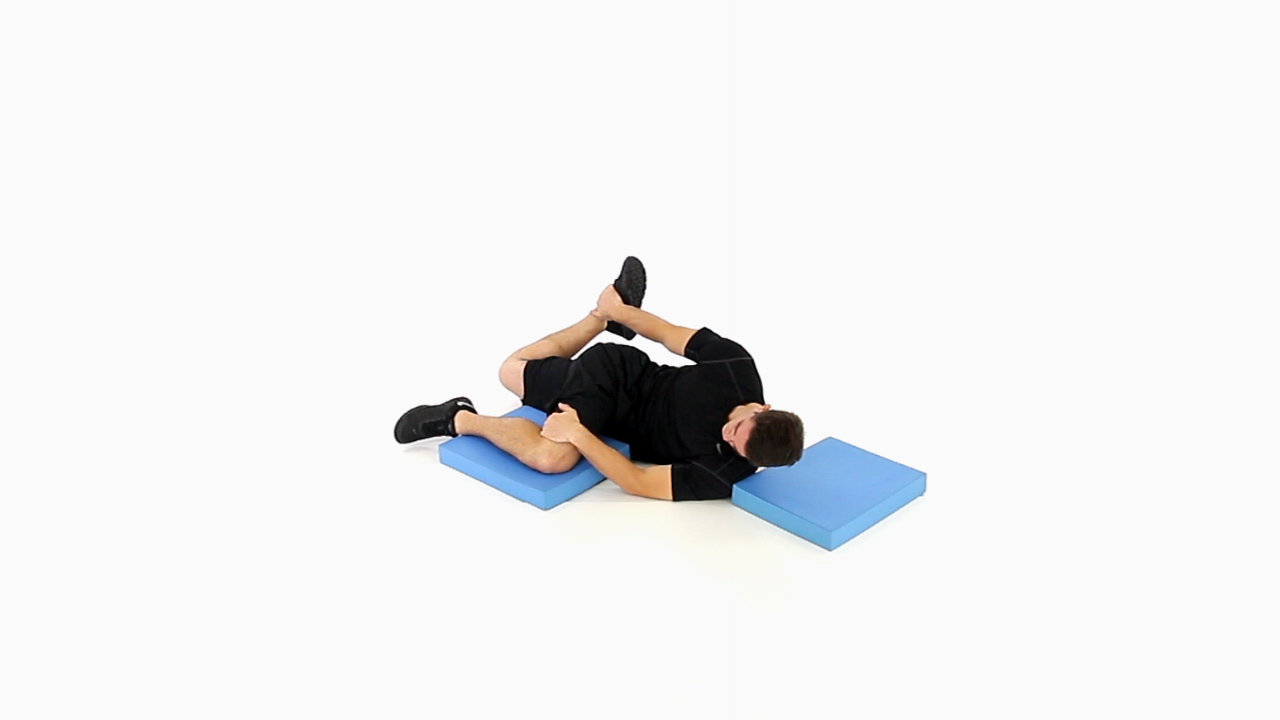
Reach  back  with  your  right  leg,  bringing  your  thigh  as  far  behind  the  plane  of  your  body  as  possible,  then  bend  your  right  knee  as much  as  possible. Try to grasp your  right ankle with your  left  hand.   Once you are in position, and not until  you  have  both  legs  secured,  proceed  to  the  next  step.

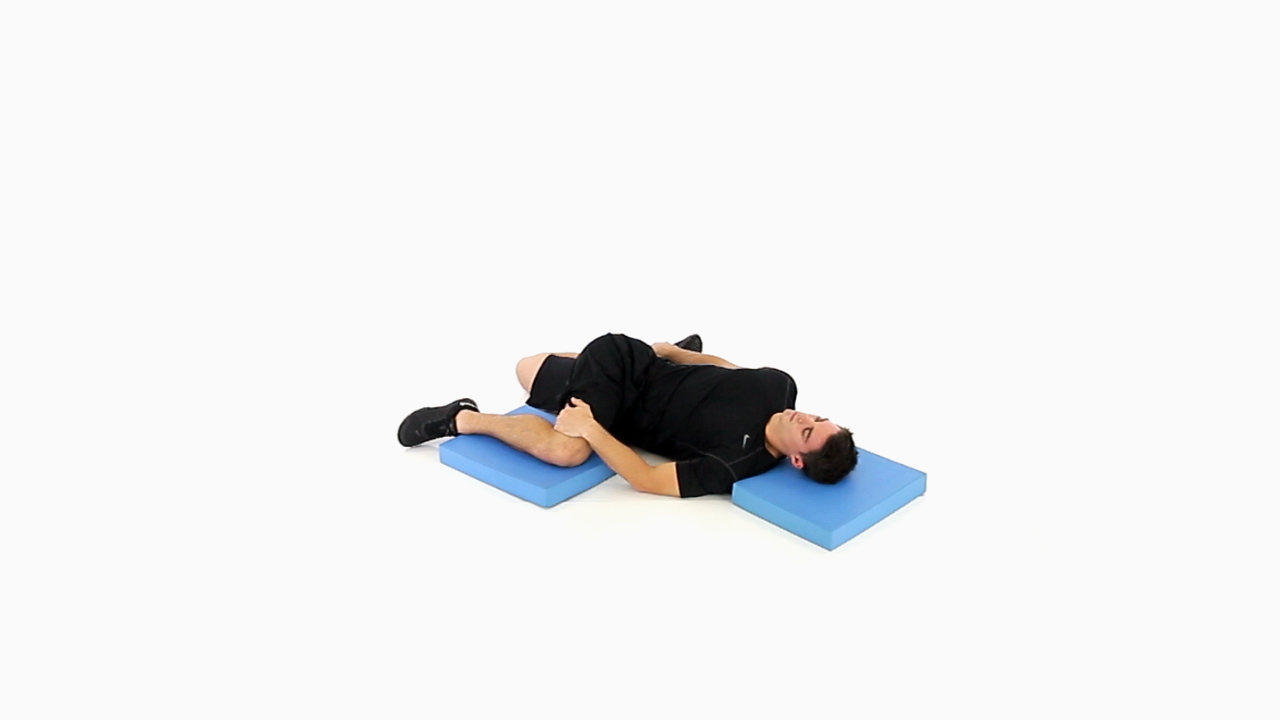
The  next  step is  a  maximal  shoulder rotation away from  the deck and toward the sky.   If you’re lying  on your right side, try  to  turn your body toward your left as far as you can. Let your neck  remain in a neutral position  and,  then, slowly look with your eyes and turn your head to enhance  the  shoulder  turn.    If you  cannot   grasp your  right  ankle  with  your  left   hand,  use  a  small loop or belt to extend your reach until your flexibility  will  allow.   Do  not drop  the maintained  left  hip  flexion  since  it  will  protect  your  low  back  and  influence  the  rotation stretch on the thoracic spine.  

The  benefits  of  this  stretch  demonstrate  a  three  dimensional  chain  of  events  that  often  play  off  of  each  other.   You  will  expose  yourself  to  any quadricep or  hip  flexor  tightness  on  the  right  leg.   You  will  also  expose  yourself to any piriformis, glute, or low back tightness with  the  left hip flexed  position.    Lastly,  once  this  position  is  maintained,  rotation  will  expose  you  to  any  T-spine  rotation  deficit.  Thoracic  spine  mobility  plays  heavily  in  shoulder mechanics  and may be  the  underlying  cause  for  shoulder  limitations.   At  no  time  should  you  strain  your  neck, but only use your  neck  turn and  your “eye  look”  to  complement the shoulder rotation that you are executing.   

Once in position, use slow, deep diaphragmatic breathing  to  relax.  To gain extra distance, pull each leg away from the arm that is gripping  it  without  actually coming  free  from  the  grip. You’re  trying  to  create  an  isometric  contraction by pulling  the  legs  towards each other against resistance.   Immediately after this contraction of trying  to extend the  left  leg  and flex  the right leg, at the hip,  relax  and  rotate  the spine an extra  few degrees, which  should  be  available  to  you  after  the  contraction.    Use  your  deep,  relaxed,  diaphragmatic  breathing and this contract-relax cycle to achieve maximal stretch in this position.

Obviously  if  there  is  any pain,  this  is  no  longer  a  stretch.  Rather,  it   is  just  an  insult  to  an  underlying  injury that  you may not be aware  of.    It  is advisable  and strongly recommended to  have a medical professional check this out.   Muscle tension and stretching  should not  be seen as  pain, but pain  isolated in  joints or  around  tendons should  definitely be  examined by a medical  professional.

Many individuals will not receive a maximal stretch on the posterior and lateral muscles in this  position. They may have  less of a  posterior-lateral mobility problem  (one  joint  limitation), and  more  of  a  posterior-lateral  flexibility  problem  (multi-joint  limitation,  usually  found  within  muscles  that  span  multiple  joints).    Since  the  iliotibial  band  (which  arises  off  the  gluteus  maximus  /  TFL)  and  hamstrings  fit  the  definition  of multi-joint muscle  tendon  packages,  a  second variation of “The Brettzel” can be done with a flexed hip and an extended knee on the top  leg.  It is advisable to perform both of these positions on one side, and then compare and contrast  the differences through the light stretch on the alternate side.

In  the  absence of pain, asymmetries should be  first and foremost addressed and normalized.  If this does not  change after one stretching session, do not give up.  Chances are, it has taken you a  long  time  to  create  the  limitations  that  you have now discovered and  it will  take  some  time  to  combat them.   Remember, tight muscles aren’t  bad muscles.   You’ve  learned how to use  those  muscles  to  move  in  a  particular  pattern,  and  your muscles  are  simply  following  the  pattern  you’ve  laid out  for  them. The FMS  corrective exercises, of which “The Brettzel”  is one, are  a  means to break those patterns.

You  can  use  this stretch  as a  super-set.   The  definition  of  a  super-set  is usually a  secondary activity that works a reciprocal muscle group or an alternate exercise that enhances the  quality  of  movement,  body  awareness  and  reflex  stabilization.    The  best  way  to  get  reflex  stabilization and have your  stabilizers work automatically is to  improve mobility.   Most  of  the  time when both flexibility and mobility are  limited, prime movers secondarily assume the  role  of stabilizers. This creates the illusion of tightness and increased muscle tone against stretching. 

Important  training  note  -  If  you  immediately  elongate  these  prime  mover muscles  and  then  continue with stabilization activities,  like a single-leg dead-lift with the alternate arm, or a Half  Get-Up,  you  will  give  your  stabilizers  an  opportunity  to  assume  their  primary  role,  thus  removing  the  obligation  of  prime  movers  to  work  in  less  than  optimal  range  of  motion.   Eventually, you can combine  this stretch with a full Turkish Get-Up to appreciate the benefit of a  mobility-stability super-set.

40 - Brettzel.Still001.png40 - Brettzel.Still002.png40 - Brettzel.Still003.png40 - Brettzel.Still004.png40 - Brettzel.Still005.png40 - Brettzel.Still006.png40 - Brettzel.Still007.png40 - Brettzel.Still008.png